







Have you ever translated a Vietnamese idiom into English and found the result strangely confusing? Vietnamese has many familiar idioms, such as “nước đến chân mới nhảy,” “ăn quả nhớ kẻ trồng cây,” and “có công mài sắt, có ngày nên kim.” If we replace each Vietnamese word with its English equivalent, readers may misunderstand the original message.
This is one of the most fascinating aspects of language. Every language is more than a communication tool. It also reflects how people think, understand the world, and preserve cultural values. Therefore, idiom translation is not simply about replacing words. It is about conveying meaning, tone, and cultural context accurately.
1. Why Are Idioms Often Difficult to Translate?
Idioms are fixed expressions whose meanings often come from a community’s experiences, customs, and history. Their intended meanings can differ significantly from the literal meanings of their individual words.
For example, the Vietnamese idiom “nước đến chân mới nhảy” literally describes jumping when water reaches your feet. However, it does not actually describe someone jumping into the air. Instead, it refers to people who procrastinate and act only when a deadline approaches.
A word-for-word English translation could create an entirely different image. Translators must first understand the intended meaning. They can then choose an expression that sounds natural in the target language.
Idioms are also closely connected to cultural images. A familiar image in Vietnamese may not create the same associations for foreign readers. This is why successful idiom translation requires linguistic knowledge, cultural awareness, and careful contextual analysis.
2. Interesting Examples of Vietnamese Idioms Translated into English
“Nước đến chân mới nhảy”: Leaving Things Until the Last Minute
This Vietnamese idiom describes people who delay their work until a deadline approaches. They often begin taking action only when a situation becomes urgent.
In English, leave it until the last minute conveys a similar idea. Depending on the context, other expressions may also be appropriate.
Translators must consider the tone of the original sentence. If it conveys humor, criticism, or advice, the translation should preserve that tone whenever possible.
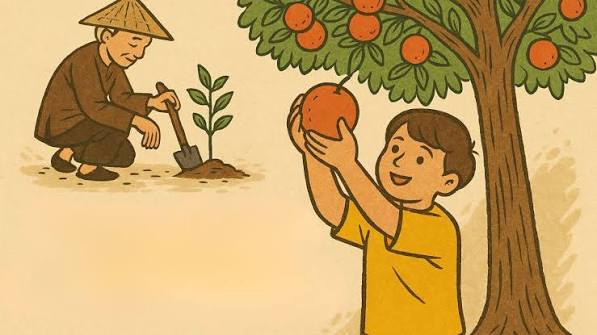
“Ăn quả nhớ kẻ trồng cây”: Remember Those Who Helped You
This Vietnamese idiom expresses gratitude toward those who have contributed to our success. It reminds people to appreciate the efforts of those who helped them along the way.
The image of enjoying fruit while remembering the person who planted the tree reflects a deep cultural value. It teaches people not to forget the contributions of others.
In English, translators might use Never forget those who helped you. In some contexts, Remember where you came from may also communicate a related idea. However, these expressions are not interchangeable in every situation.
If a text emphasizes traditional values, translators may preserve the original imagery and provide a brief explanation. For speeches or practical documents, a more direct English expression may communicate the message more effectively.
“Có công mài sắt, có ngày nên kim”: Where There’s a Will, There’s a Way
This Vietnamese idiom emphasizes perseverance and sustained effort. Its imagery describes grinding an iron bar until it becomes a needle.
The message is simple: even difficult goals can become achievable through patience and determination.
In English, Where there’s a will, there’s a way expresses a similar idea. It emphasizes determination and the ability to overcome obstacles. Meanwhile, Practice makes perfect is more suitable when discussing skill development through repeated practice.
Although both expressions share related meanings, neither replaces the Vietnamese idiom perfectly in every context. Translators must identify the main message before choosing the most suitable expression.

3. Should Translators Preserve the Original Imagery?
Translators do not always need to preserve an idiom’s original imagery. They can choose among several approaches depending on the purpose of the text.
First, use an equivalent idiom in the target language. This approach works when the target language has a natural expression with a similar meaning and tone. It helps readers understand the message without additional explanation.
Second, paraphrase the intended meaning. When no suitable equivalent exists, translators can express the message in ordinary language. This method is especially useful for informational articles, instructions, and texts that prioritize clarity.
Third, retain the cultural imagery and explain it when necessary. This approach suits literary works, cultural studies, and materials introducing traditional customs. It allows readers to understand both the message and the cultural background.
No single approach works for every situation. Translators must consider the audience, purpose, text type, and readers’ familiarity with the source culture.
4. What Skills Do Translators Need to Translate Idioms Accurately?
Effective idiom translation requires more than consulting a dictionary. Translators must understand the full context, including the speaker, audience, and purpose of the expression.
They should also consult reliable idiom dictionaries, linguistic references, and examples of actual usage. Comparing multiple sources helps prevent translations that are technically correct but sound unnatural.
Cultural knowledge is equally important. An expression may convey humor, sarcasm, advice, or criticism. Ignoring these nuances can distort the speaker’s intended attitude.
Finally, translators should review their work within the complete text. An expression may seem correct on its own but sound inconsistent with the overall tone. For important documents, checking terminology and consistency also helps improve translation quality.
5. Professional Translation: Conveying Meaning Beyond Individual Words
Differences between languages show why high-quality translation requires more than replacing words. Translators must understand the content, recognize subtle nuances, and choose expressions that suit the target audience.
This principle applies not only to idioms but also to personal documents, academic materials, contracts, business documents, and specialized texts. Each type of document has specific requirements for terminology, style, and accuracy.
Dịch thuật Châu Á provides multilingual translation services for a wide range of documents. Choosing an appropriate translation approach helps ensure that information remains clear, consistent, and suitable for its intended purpose.
If you need translations of personal documents, academic records, business documents, or specialized materials, contact Dịch thuật Châu Á. Our team can advise you on translation services, document requirements, and relevant certification procedures based on your specific needs.
DỊCH THUẬT CHÂU Á – Success is the sum of sincerity and goodwill.
Website: https://dichthuatchaua.com
Hanoi: Hotline 093.223.2318 | Tel: 024 3990 3758
Ho Chi Minh City: Hotline 093.223.7939 | Tel: 086 682 9216
Email: hanoi@dichthuatchaua.com – saigon@dichthuatchaua.com
Bài viết liên quan